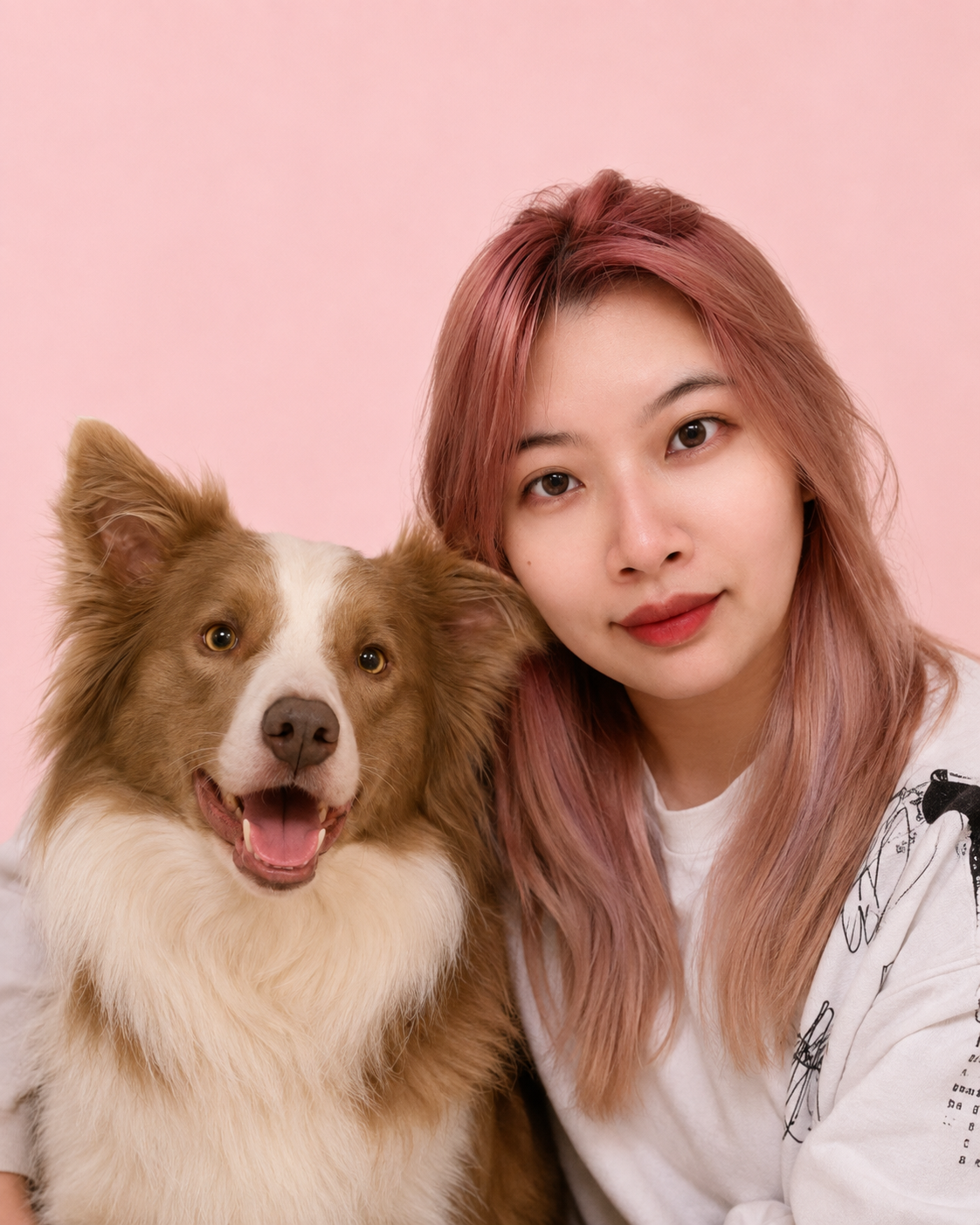
Hi, I'm Yingshan
Hi, I'm Yingshan, and this is my dog, Croissant.
Hi, I'm Yingshan, and this is my dog, Croissant.
Product Design Leader | AI Platforms and Cross-Product Experience Strategy | Dog Mom
Design is what I will still be doing long after I retire.
Product Design Leader | AI Platforms and Cross-Product Experience Strategy | Dog Mom
Design is what I will still be doing long after I retire.
Product Design Leader | AI Platforms and Cross-Product Experience Strategy |
Dog Mom
Design is what I will still be doing long after I retire.
Product Design Leader | AI Platforms and Cross-Product Experience Strategy | Dog Mom
Design is what I will still be doing long after I retire.
Product Design Leader
AI Platforms and Cross-Product Experience Strategy
Dog Mom
Design is what I will still be doing long after I retire.
Fourteen years of reinventing my craft,
from a motion & interaction designer to shaping the way AI works by user experience design.
At Palo Alto Networks, I design AI products every day: evolving AI Canvas and the experiences around it, where the questions keep getting harder and more interesting. I also strengthen our design standards so quality scales beyond any single designer, still validate my own designs in code with React and AI, and am exploring agentic workflows that could audit design quality automatically.
Alongside that work, I keep asking what UX and AI owe society. That question became Elta: an AI-powered eldercare concept designed for the moment someone is least capable of using an interface, where help arrives without being summoned. It is now a UX Design Awards nominee (Autumn 2026, IDZ Berlin). Its hardest design decision was ethical, not visual: when several seniors need help at once, the system prioritizes by transparent medical risk signals, never by personal attributes, because every life carries equal weight.
The tools keep changing. The curiosity doesn't.
AI Canvas shipped: a generative AI platform I led from first sketch to release, letting security teams create data visualizations by simply asking in plain English. The hardest problem was not generation, it was trust. I designed the confirmation patterns that let people verify what AI builds before it builds it, translating model uncertainty into interaction design.
At Palo Alto Networks I taught myself a new discipline, data visualization at scale, and ran it through seven release iterations of AIOps for NGFW, the industry's first (recognized in The Forrester Wave, Q4 2022). By 2023, my design language ran across Strata Cloud Manager, the industry's first AI-powered unified management platform. My experience strategy spans Advanced WildFire, Activity Insights, ZTNA Connector, IoC Search, Reports, and Custom Dashboards, and the platform's modernized visual identity grew from a UI design system I created, including a Dark Theme component library with 24 component branches adopted by the central design team.
My MFA thesis pushed data visualization to its edge: the Conceptual Interstellar Map, a sci-fi navigation and status panel system for space travel, where visualization replaces human spatial intuition entirely. The thesis was published in RIT's research repository. My motion craft stayed sharp too: a title sequence, Design for NASA TV, was named a finalist at MODE Fest, an international competition that drew 331 entries from around the world. Across it all, I learned that the hardest design problem is making the invisible understandable.
The question that brought me to RIT followed me into the work. For my Water Monitor concept, I interviewed households across four countries, in America, China, Canada, and Sweden, to understand how differently people relate to something as universal as water. I also stretched my visual language in the other direction, collaborating with astrophysicists to visualize black hole dynamics, translating research too vast to see into something people could grasp.
By 2016, after designing across ten industries in China, one question kept pulling at me: user experience means designing for people, so how do other cultures design for their people? I decided to find out firsthand. I had never worked in English, so I studied the language from the ground up, passed the exams, and entered the MFA program at RIT, a school with a deep design foundation in the United States.
At Dalian Wanda Group I built the company's first motion design team from zero, not to manage but to multiply: training designers across ten industries until motion thinking became part of how the whole organization designed. I grew there under Cheng Chang, my design leader and mentor, one of the three designers who crafted the cloud pattern of the 2008 Beijing Olympics torch. The platform work from that era was later documented in his book, The Art of Interaction Design (Tsinghua University Press, 2022, ISBN-13: 978-7302602514).
At Lenovo, since 2011, I designed motion and Interaction for Aura, the multi-user, multi-touch interface at the heart of the IdeaCentre Horizon 27, the world's first “interpersonal PC,” unveiled at CES. Watching four strangers gather around one screen and instantly know what to touch: that was the moment design stopped being a job for me. The work earned the iF Design Award, the Red Dot Design Award, and two national patents: Information Processing Method and Electronic Equipment, and Information Processing Method and Terminal Equipment.